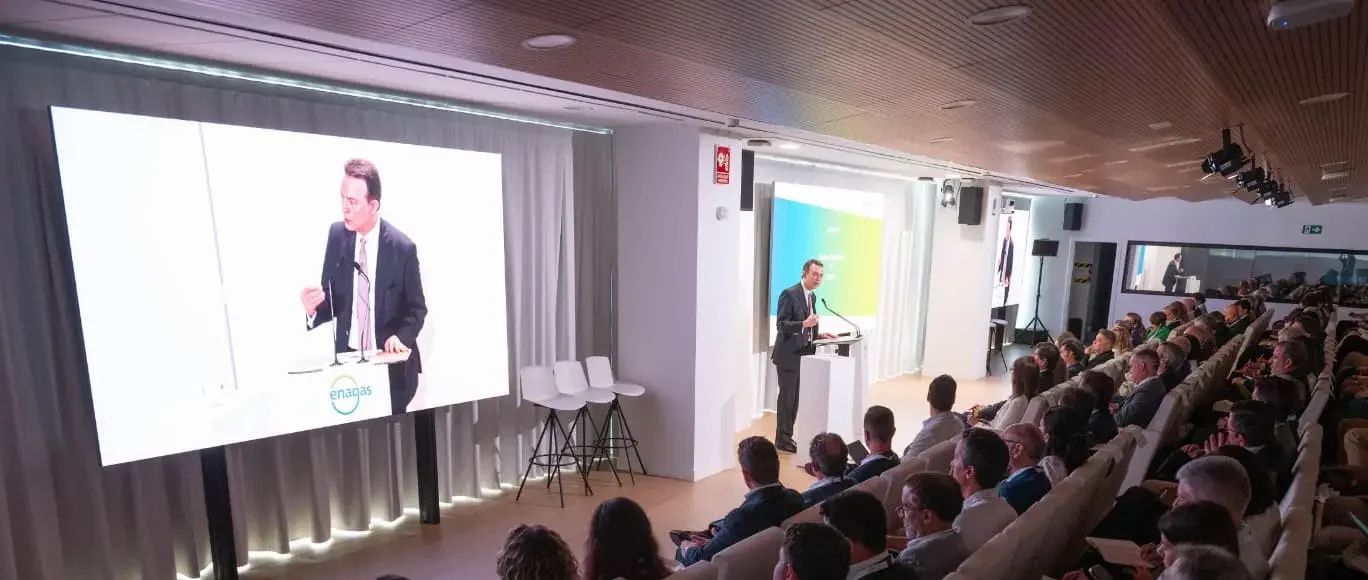
Year after year, the Enagás H₂ Technical Day continues to consolidate its position as a key event for the exchange and dissemination of knowledge on green hydrogen and decarbonisation. The third edition of the event, which took place at the Enagás Corporate University, attracted representatives from industry, academia, public authorities and other key stakeholders across the hydrogen value chain.
Throughout the day, topics such as hydrogen production, transmission, supply and demand were discussed. Ongoing initiatives were presented, a range of projects and start-ups were analysed, technologies at different stages of maturity were explored, and experiences of implementing solutions in real-world environments were shared. This exchange of knowledge contributes to addressing the various challenges facing the sector.
The Technical Day provided an insight into the current state of the green hydrogen ecosystem and its role in helping to reduce Spain’s and Europe’s energy dependence. In the current climate of energy volatility, driven by factors such as international conflicts, renewable hydrogen is set to become one of the domestic energy sources that will reduce Europe’s exposure to such instability.
Arturo Gonzalo, the CEO of Enagás who was responsible for opening the event, emphasised that renewable hydrogen is at a crucial juncture in its development. “We must put technological development at the service of competitiveness. Many technologies across the value chain have been proven, but we need to scale them up and keep moving forward. This is the key turning point for improving the competitiveness of hydrogen”.
Amalia Pizarro, an Energy Technology Analyst at the International Energy Agency (IEA), discussed the global landscape for low-emission hydrogen in terms of investment, highlighting that investment reached almost US$7 billion in 2025. “If we take into account the projects already under construction, we can see that investment in low-emission hydrogen doubled in 2025 compared to 2024. Based on projections for 2026, taking into account the projects currently under construction, we can see that these investments are set to increase by 50%. This is a very significant increase”.
Antonio Chica, Coordinator of the Global Materials Division at the Spanish National Research Council (CSIC), emphasised that the success of the hydrogen economy will depend not on a single technology, but on the ability to integrate multiple scientific innovations and translate them into industrial value. “It’s not just about developing scientific knowledge; it’s about transforming it into technologies capable of delivering a real impact and being applied to the development of hydrogen-related technologies,” Chica emphasised.
The first round-table discussion of the day made it clear that several industrial sectors have moved on from merely studying hydrogen to actively adapting and integrating its use in their production processes. The cases presented varied in scale and sector.
Gotzon Gómez, Stegra’s director for Spain and Portugal, explained the scale of the process involved in using green hydrogen in steel production. Stegra is a Swedish company building the world’s first large-scale low-emission steel plant. The plant, which is located in Boden, in northern Sweden, will have 740 MW of electrolysers and will consume 100,000 tonnes of renewable hydrogen per year. The total investment amounts to 10 billion euros.
“We use green hydrogen to process iron ore instead of coal, as is usually the case, and only emit water vapour. “That’s how green iron is produced,” emphasised Gómez, who added that certain market segments, including brands such as Porsche, BMW, Mercedes, Volvo, Microsoft, IKEA and Electrolux, are willing a green premium.
Manuel Breva, general secretary of ANFFECC (the National Association of Manufacturers of Frits, Glazes and Ceramic Colours), presented the results of the H2Frit project. This involved carrying out tests to determine the technical feasibility of using hydrogen in their processes. In sectors such as the ceramics industry, kilns are used that reach temperatures of between 1,200 and 1,500 degrees Celsius and operate 24 hours a day, 365 days a year. “We gradually introduced different percentages of hydrogen into the combustion process until we reached 100%. We can say that the project has been a success. We have achieved the same technical standards,” said Breva.
From an energy perspective, the results are of significant importance to a sector that is deeply rooted in the province of Castellón and accounts for 8% of Spain’s total industrial gas consumption. Demonstrating that production processes can run on hydrogen without losing competitiveness paves the way for decarbonisation.
In 2022, Moeve announced its ‘Positive Motion’ strategy, which includes the objective of developing 2 GW of electrolysis capacity in order to decarbonise its own fuel-related road transport operations, as well as the industrial operations of its customers and its own industrial operations in the regions where it operates. “This is a project that is being developed in phases as demand becomes clearer. The FID (Final Investment Decision) we made in March is for 300 MW,” explained Olivia Infantes, the company’s director of Regulation and Public Financing for Hydrogen, Derivatives and Clean Energy.
She emphasised that, while refineries already have experience in using hydrogen, the challenge now lies in the technical aspects involved in electrolytic production and the production of alternative fuels such as ammonia, methanol and sustainable aviation fuel (SAF). “Collaboration is the key word when it comes to hydrogen. We are working with many technologists,” she said.
Siemens Energy brought the panel to a close by presenting the equipment manufacturer’s perspective. Germany has launched tenders for a further 9 GW of combined-cycle power stations, which must be climate-neutral by 2045. The industry’s response is H₂-ready turbines, which run on natural gas and can accommodate increasing blends of hydrogen, and can ultimately run on 100% hydrogen once the infrastructure is in place. “We have been working for decades on developing gas turbines that can run on 100 per cent hydrogen. We have a fully defined roadmap and have taken all the necessary steps,” explained María Jazmín Nieto, Head of Gas Turbine Sales and International Projects at the German energy group.
A single large-scale turbine consumes over 41 tonnes of hydrogen per hour at full load, illustrating the scale of demand that this sector will generate once the market has reached an advanced stage of development. “We need a network like the one you are developing here in Spain, as well as in Germany. “The fact that it is connected to other European countries will enable the flow of hydrogen,” she said, referring to Spain’s future hydrogen backbone network and interconnections such as H2med.
The second round-table discussion focused on heavy-duty transport, with contributions ranging from road transport to the maritime sector. For example, Daimler Truck highlighted its commitment to liquid hydrogen for long-distance heavy goods transport by road. This technology can achieve ranges that are currently difficult for battery-powered solutions to match on routes such as those linking Spain with Germany or northern European markets.
At sea, PowerCell develops megawatt-scale fuel cell systems for ferries, bulk carriers, and cruise ships. These systems are designed to withstand the marine environment, as well as the vibration and shock that are typical of such conditions. Victor Akerlund, SVP Analytics & Sustainability, pointed out that the maritime sector meets two ideal conditions for launching the market: a high willingness to pay for hydrogen and stable, long-term demand. The port of Algeciras could also have access to an estimated potential output of around 800,000 tonnes per year.
The final session of the day explored how to turn scientific knowledge into viable industrial products, with examples illustrating different paths towards the same target.
The Aragón Institute of Technology (ITA) is leading H2MAC, a European project that will demonstrate the operation of a fuel-cell-powered excavator and crusher at a quarry in Arcos de la Frontera. EVARM has announced that it will unveil its first heavy-duty hydrogen fuel cell truck at the Green Gas Mobility Summit 2026. Manufactured entirely in Spain, the truck is the result of four years of development and four appearances in the Dakar Rally as an extreme testing ground. Trials carried out with Transportes Metropolitanos de Barcelona have demonstrated that the same technology can operate for 16 hours between refuelling.
Kalfrisa, an Aragonese company with six decades of experience in industrial equipment, has built its own validation centre to test hydrogen combustion in real furnaces. The result is 100% hydrogen combustion with up to 500 kW of thermal power whilst maintaining process parameters. Kalfrisa is now passing on the knowledge it has gained to its industrial clients, supporting them in their own decarbonisation roadmaps.

