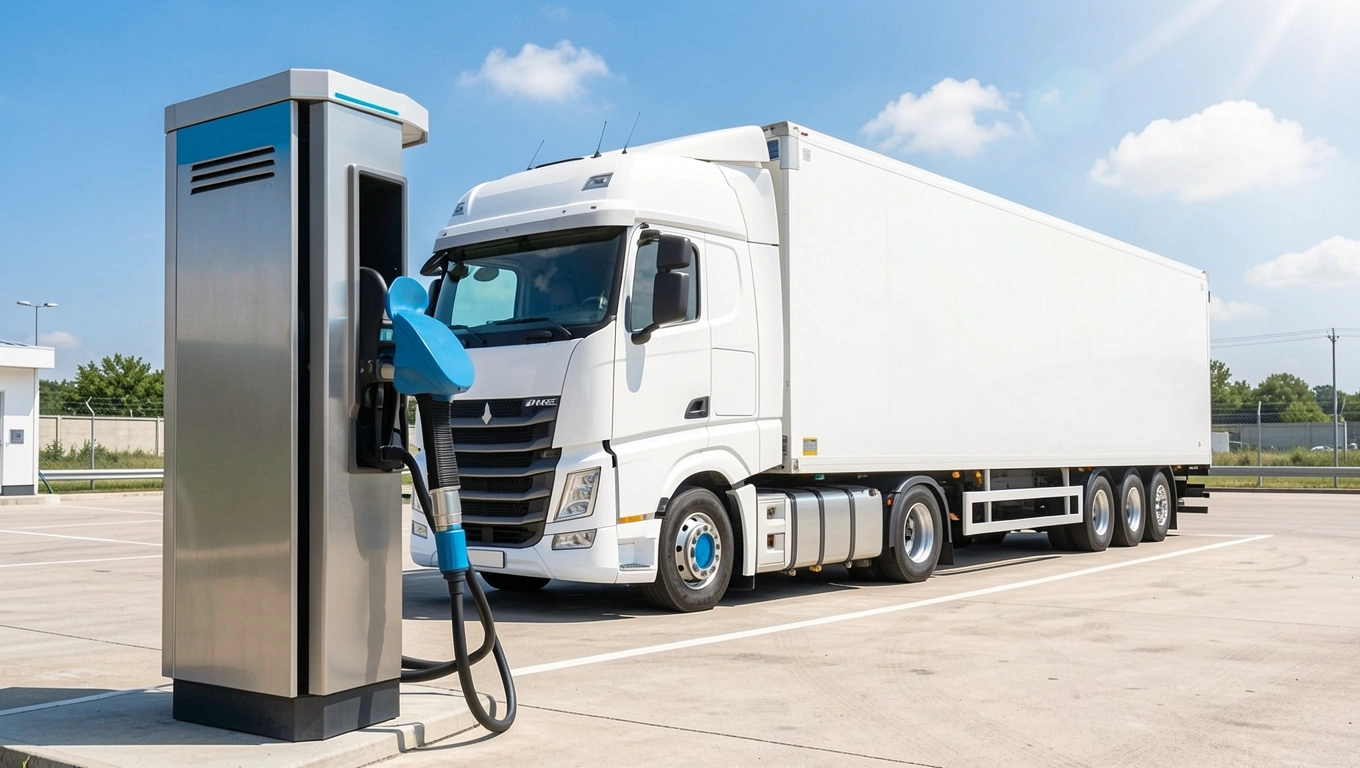
As the green hydrogen market develops in Spain and Europe, the infrastructure required for its deployment is attracting greater interest from different sectors that view this energy carrier as an optimal solution for decarbonisation and reducing energy dependence. The mobility sector, particularly heavy transport, relies on hydrogen refuelling stations (HRS) to access the green hydrogen needed to decarbonise its operations.
Green hydrogen, produced through electrolysis using renewable electricity, offers high energy density, short refuelling times, and a range that can cover long distances in zero-emission vehicles. These characteristics make it an ideal fuel for medium and long-distance heavy-duty transport, including freight trucks and passenger buses, as well as heavy-duty fleets.
The RED III Directive (Renewable Energy Directive III), which forms part of the European Union’s legislative package aimed at decarbonisation and the energy transition, sets out concrete targets for renewable fuels. It stipulates that, by 2030, more than 1% of transport energy consumption must come from renewable fuels of non-biological origin (RFNBO), such as renewable hydrogen and its derivatives.
The European Union’s REPowerEU plan aims to produce 10 million tonnes of renewable hydrogen by 2030, prioritising its use in sectors that are difficult to electrify, such as heavy transport. Additionally, Spain’s PNIEC 2023‑2030 proposes installing up to 12 GW of electrolysers by 2030.
These production capacity targets and initiatives contribute to the development of a hydrogen refuelling station network and the use of hydrogen in heavy goods and passenger transport fleets. The European Union has also introduced regulatory instruments to provide further impetus, such as the Alternative Fuel Infrastructure Regulation (AFIR), which sets binding targets for the rollout of alternative fuel infrastructure, including hydrogen refuelling stations, along the Trans-European Transport Network (TEN-T) and in urban centres.
As hydrogen refuelling stations are rolled out, here are some frequently asked questions and answers about this type of infrastructure.
Hydrogen refuelling stations are similar to traditional filling stations, but instead of supplying petrol or diesel, they supply hydrogen to hydrogen-fuelled vehicles. They are facilities where the reception, compression, storage and dispensing of hydrogen can be managed, thus connecting production with final consumption wherever required.
In this way, a hydrogen refuelling station can supply green hydrogen to vehicles and enable mainly trucks, buses and other heavy-duty vehicles used for professional purposes to integrate green hydrogen into their operations. This facilitates decarbonisation by providing a fuel that can meet their usage requirements in both urban environments and strategic transport corridors.
The process of operating a hydrogen gas refuelling station can be divided into several phases.
Generally speaking, hydrogen gas refuelling stations share a basic architecture comprising several systems for receiving, conditioning and delivering hydrogen safely and efficiently.
This may include on-site hydrogen production by electrolysis or hydrogen supply via pipelines or specialised transport (such as semitrailers), if hydrogen production is at a different location.
Its function is to raise the hydrogen pressure to the level necessary for subsequent storage.
Hydrogen is not usually refuelled directly into the vehicle. It must first pass through a buffer storage system, which is usually organised in pressure banks in a cascade configuration. This allows the compression process to be decoupled from the refuelling process. This ensures sufficient flow rates to provide an adequate user experience in terms of refuelling times and to meet the operational needs of consecutive refuelling of several vehicles.
The main element in the refuelling process is the dispenser, which connects the station to the vehicle and acts as a refuelling regulator. It controls key factors such as hydrogen pressure, temperature and flow rate.
To enable fast and safe refuelling, particularly at high pressures, hydrogen refuelling stations incorporate a cooling system that pre-cools the hydrogen before it enters the vehicle.
In addition to the components that ensure the hydrogen refuelling station operates optimally, there are also auxiliary control, safety and instrumentation systems. These elements monitor the pressure and temperature of the hydrogen, as well as the status of ventilation, electronics and crucial safety features such as fire protection. All of this ensures safety and compliance with technical and regulatory requirements for hydrogen refuelling.
The deployment of an adequate network of hydrogen refuelling stations contributes directly to meeting the climate targets set by the European Union and Spain. In certain cases, hydrogen enables heavy-duty transport to achieve ranges similar to those of diesel-powered vehicles. This is a key factor in sectors such as logistics and intercity transport.
Another advantage of this energy source is that it does not necessarily compete with battery-based electrification; rather, the two technologies complement each other. While battery electric vehicles are ideal for urban or short-distance journeys, hydrogen is proving to be a particularly effective solution for intensive medium- to long-distance transport needs.
Green hydrogen is the most sustainable option, as it is obtained by electrolysis using renewable electricity
According to data from the Gasnam website, in the Iberian peninsula there are currently:
They are located in places such as Puertollano (Ciudad Real), Huesca, Zaragoza, Fuerteventura, Tarragona, Madrid and Barcelona.
Notable projects include those in Seville, Palma de Mallorca, Bilbao, Vigo, Pontevedra, Madrid, Córdoba and Zaragoza.
Yes. Refuelling hydrogen is safe, as hydrogen refuelling stations are subject to stringent regulations and their design is intrinsically safe. These installations incorporate various safety systems, such as safety valves, detection systems and automatic shut-off mechanisms, to ensure safe operation at all times. Likewise, the vehicle filling process is carried out in accordance with protocols developed by prestigious standardisation bodies to ensure that the operation is carried out within controlled and safe parameters.
Organisation such as the CEP have been monitoring and promoting safety in this type of operation for decades, actively contributing to the development and updating of the regulations governing these infrastructures.
Although hydrogen has different properties to those of liquid fuels, technological advances have made it possible to develop highly safe and reliable infrastructure for its use in mobility.
In short, hydrogen refuelling stations are establishing themselves as an strategic infrastructure for promoting hydrogen-based mobility in Spain, particularly in sectors such as heavy transport, where autonomy and refuelling speed are key to facilitating decarbonisation. As these stations are deployed and renewable hydrogen becomes more available, they will play an increasingly important role in the transport sector’s energy mix, complementing solutions such as electrification and reducing dependence on fossil fuels.
The development of hydrogen infrastructure will contribute not only to reducing transport emissions, but also to positioning Spain as a leading player in the transition towards a more sustainable, innovative, and self-sufficient energy model.
If you would like to find out more about the characteristics of this type of facility and learn more about the specifics of using hydrogen in transport, you can consult the report on hydrogen as a vector for land mobility recently published by the Hydrogen Technology Observatory.

