Nowadays, talking about renewable hydrogen in Europe increasingly means discussing Spain. After barely a few years, the country stands centre stage in the major talks on decarbonisation, energy sovereignty and green re-industrialisation. This is no coincidence. Spain brings together a combination of factors that are difficult to replicate in other European regions, including plentiful renewables, experience of energy infrastructures, a key geostrategic position and an aligned public and business strategy.
The result is obvious. Large-scale projects, investments and a network of public and private players who are already working on a shared goal: to turn Spain into one of the major European hubs for producing, consuming and exporting renewable hydrogen.
Renewable hydrogen is produced by means of water electrolysis using electricity from renewable sources. This means that the cost and availability of the electricity are decisive factors. In this regard, Spain enjoys the upper hand.
The country boasts one of the greatest potentials for solar and wind power in Europe, and this is reflected in a growing capacity to generate clean electricity at competitive prices. Added to the above is a terrain that allows the deployment of large renewable projects and an electricity grid that’s increasingly prepared to integrate new generation. Within a European context shaped by the need to reduce external energy dependence, this combination is particularly attractive.
The Iberian Peninsula serves as a natural gateway between southern Europe and the continent’s major industrial hubs
But energy isn’t Spain’s only competitive edge. It’s geography is one too. The Iberian Peninsula serves as a natural gateway between southern Europe and the continent’s major industrial hubs Today, thanks to hydrogen, it’s becoming a major strategic asset.
The one project that symbolises Spain’s new role on the European energy map is H2med. This is the first major renewable hydrogen corridor conceived on a European scale with a clear objective, namely to connect the production capacity in south-west Europe with industrial demand in central and northern Europe.
H2med is an infrastructure that will be able to transport up to two million tonnes of renewable hydrogen each year. This figure alone will give readers an idea of the scale of the project.
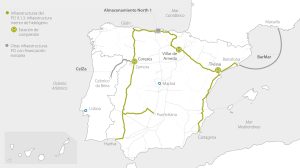
The corridor is divided into two main sections. Firstly, CelZa, the overland interconnection linking Portugal and Spain via Zamora. Secondly, BarMar, an underwater pipeline set to connect Barcelona and Marseille, which will be key to transmitting Iberian production directly to the French market and, thereafter, to the European industrial hub.
BarMar is particularly significant, not only due to its technical complexity, but also because it constitutes a paradigm shift; for the first time, Europe is designing a major cross-border infrastructure designed from the outset for hydrogen as the energy carrier of the future.
Enagás has taken on a leading role in this process. The company, the operator of the Spanish natural gas network, is one of the main drivers of renewable hydrogen in the country.
Enagás is leading the design of a domestic infrastructure that will connect production areas, large industrial centres, storage facilities and export points
Designated as the provisional operator of the Hydrogen Backbone Network, Enagás is leading the design of a domestic infrastructure that will connect production areas, large industrial centres, storage facilities and export points. It will be a network covering over 2,600 kilometres, one that’s set to become the backbone of the future hydrogen energy system in Spain.
Beyond the engineering work, in accordance with European Regulation 2022/869, Enagás is deploying the Public Participation Plan across the country. This is one of the most ambitious plans carried out to date and it seeks to involve autonomous communities, local councils, companies and citizens in defining the network’s routes and priorities.
Moreover, its participation in international projects such as H2med and its partnerships with major European energy players reinforces the idea that Spain, in addition to enjoying great potential when it comes to hydrogen production, will play an essential role in its transmission and marketing across the continent.
The promotion of renewable hydrogen in Spain wouldn’t be possible without a clear commitment from the public sector. In recent years, the Government has mobilised billions of euros in aid, a large part of it from European funds, in order to accelerate hydrogen-related industrial projects.
According to the Project Census of the Spanish Hydrogen Association (AeH2), the declared installed capacity of electrolysis until 2030 is now estimated to total around 13.3 GW, a figure that exceeds the original target of the Integrated National Energy and Climate Plan (PNIEC), which set the goal of 12 GW for the above year.
In this regard, some of the most visible axes are the so-called hydrogen valleys, industrial clusters that integrate the development of production, storage and consumption. Andalusia, Aragón, Castile and León, Catalonia and Galicia have some of the most ambitious projects, with electrolysis capacities leading Spain to rank among the leading countries in Europe.
Some of the most visible axes are the so-called hydrogen valleys, industrial clusters that integrate the development of production, storage and consumption.
The above comes in addition to Spain’s success in community initiatives such as the European Hydrogen Bank. A significant part of its selected projects will be undertaken in Spain. Beyond the direct funding, this European backing sends out a clear message to the market: Spain is a reliable and competitive destination for investments in renewable hydrogen.
The development of hydrogen opens up opportunities that go far beyond the energy sector. For regions with an industrial tradition, hydrogen can become a key tool for decarbonising intensive processes and maintaining activity and employment. For other areas, especially rural ones, it can be a way of attracting investment, infrastructures and new projects linked to renewables.
Sectors such as the chemical and steel industries, heavy transport and agriculture are looking to hydrogen as a realistic medium-term solution. Spain, due to its production capacity and its future European connectivity, is positioning itself as a key supplier for all of them.
Furthermore, the interest in storage solutions such as saline cavities reinforces the concept of a more flexible energy system that’s capable of managing the intermittent nature of renewables and guaranteeing a continuous supply.
Renewable hydrogen looks set to become one of the major levers of Europe’s energy transition. Spain has taken on a leading role in this scenario.
The combination of natural resources, strategic projects such as H2med, the leadership of actors such as Enagás and sustained public support is laying the foundations for a stable and credible ecosystem. An ecosystem that not only contributes to the climate goals, but also redefines Spain’s role on the energy and geopolitical map of Europe.

