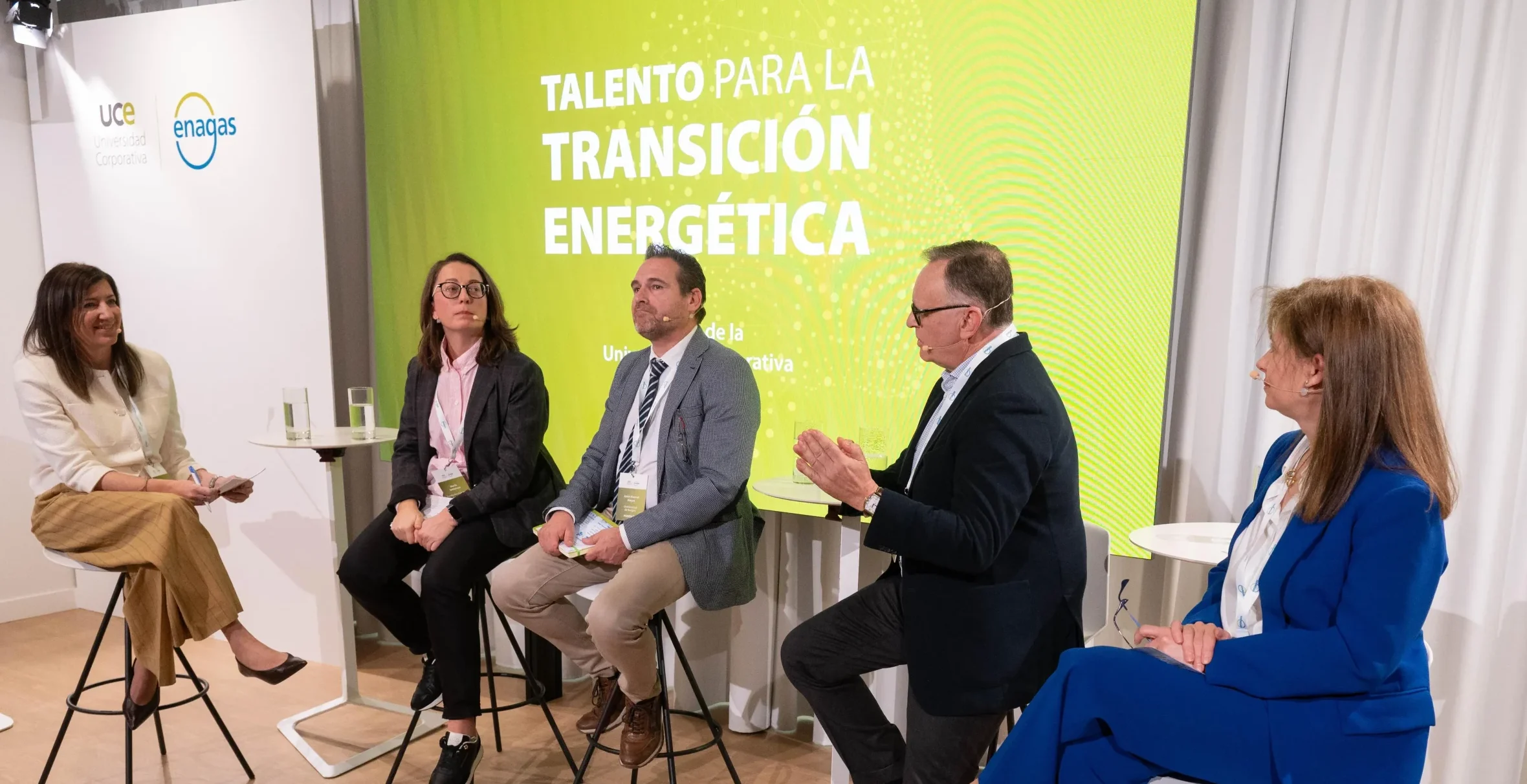
The Enagás Corporate University (UCE) celebrated its first anniversary in Madrid, having already established itself as a leading provider of energy sector training. In its first year, the UCE delivered over 92,000 hours of training across 1,400 courses for 1,263 professionals, averaging 67.5 hours per employee. The event brought together representatives from institutions, companies, universities, and technology centres. It served to take stock of the situation and also address one of the sector’s major challenges: the need for human talent ready to sustain the energy transition.
The event revealed that training is no longer just a support element; it is a structural lever. This is reflected in the approach of the Enagás Corporate University, which is aligned with the company’s own transformation and is designed to provide skills applicable to current challenges, such as the development and management of future hydrogen storage and transport infrastructures.
The event also provided an opportunity to demonstrate how this training model, which is already a benchmark for the energy sector, is constructed. The UCE is headquartered in Madrid and has technical centres in Madrid and Zaragoza, taking an eminently practical approach based on the simulation of real cases.
The university’s structure is organised around three major knowledge institutes. The technical institute addresses key issues such as energy infrastructures, renewable gases, hydrogen and new molecules. The leadership institute promotes a transformational model adapted to today’s challenges, while the corporate institute focuses on areas such as business continuity, communication, finance, and digital transformation.
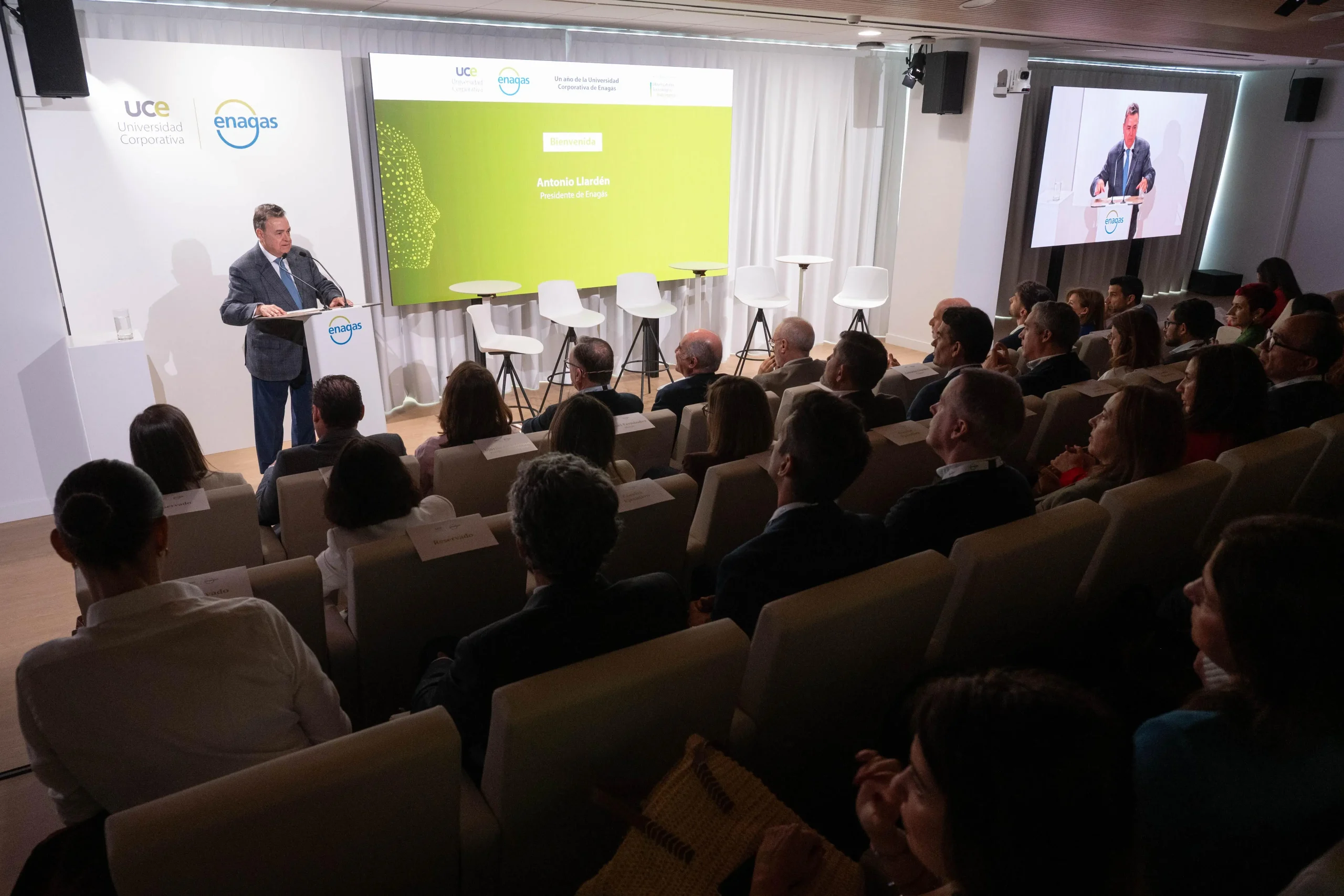
Many of the talks focused on the theme of talent as a key issue, even more important than technology itself. “We all agree that one of the critical factors for a successful energy transition is talent,” said Antonio Llardén, Chairman of Enagás, during the event’s opening. He emphasized the importance of “developing new capabilities, attracting and retaining diverse talent, and making a real impact on society”.
In parallel, the company has established the Hydrogen Technology Observatory, a project with over 100 partners spanning the entire value chain. The observatory also acts as a platform for knowledge sharing and trend anticipation around one of the key vectors of the transition: green hydrogen.
Enagás created the Hydrogen Technology Observatory, an initiative that in just two years already has more than 100 partners spanning the entire value chain
Regarding the knowledge needed in the energy sector, Juan Cruz Cigudosa, the Secretary of State for Science, Innovation and Universities, who also participated in the event, reinforced the idea that the energy transformation goes far beyond technology. “The energy transition is only possible if there is a transition of talent. It is not only technological; it is also social and cultural,” he said.
Cigudosa also provided data revealing the current state of this technological talent. According to the latest report by the Cotec Foundation, 240,000 technology jobs have been created in Spain since the pandemic, with digital services accounting for 80% of this growth. “Technology jobs have never been created at such a rate,” he stressed.
Regarding public investment, Cigudosa highlighted the 178 million euros allocated by the State Research Agency between 2018 and 2025 for projects related to the energy transition and hydrogen, as well as the 92 million euros mobilised through the Complementary Plan for Renewable Energy and Hydrogen R&D&I, in which ten autonomous communities participated.
Dominik Richter, Project Manager of Hydrogen Europe Research, addressed the European dimension of talent by presenting the Green Skills for Hydrogen initiative. This organisation has 172 members in 30 countries and over 900 scientists involved, and is working to define training priorities for the sector.
“Initiatives such as the Corporate University translate industry needs into specific skills requirements”: Dominik Richter, Project Manager at Hydrogen Europe Research
Richter emphasised a key point: “Hydrogen is not a single profession”. The transition requires hybrid and cross-cutting skills, many of which come from adjacent sectors such as gas and renewables.
However, the current landscape presents major challenges, including a lack of specialised trainers, insufficient flexibility in educational pathways, an absence of infrastructure for practical training, and no clear certification standards.
Using interviews with 146 stakeholders in 23 countries, Richter identified the profiles in especially high demand in the renewable hydrogen sector:
The event also featured a roundtable discussion organised by the Hydrogen Technological Observatory and moderated by Lorena Díaz, Enagás’ Director of Transformation and Talent.
Mariia Iamkovaia, from the Aragon Hydrogen Foundation, focused on the human dimension of the transition and the need to align training with the industry’s real demands: “We are not just talking about infrastructure and investment, but also about people who are prepared to install, maintain and operate projects”.
Professor Jesús Manuel Alegre, from Burgos University, emphasised the importance of collaboration between universities and companies to promote applied research. “If we don’t create environments with professional prospects, we will train talent, but we won’t retain it,” he warned.
Rafael Fernández, Moeve’s Talent Director, explained how the transition affects the entire value chain of companies, emphasising that it is not just a matter of training technical staff but of training everyone involved in the value chain. “We have identified about 80 skills needed for this process”.
Mar Samperio, Human Resources Director at Robert Bosch Spain, gave her thoughts on cultural change: “We are not talking about ready-made talent, but people with the willingness to learn”. In her view, “the energy transition represents an opportunity and a lever for professional growth.
The first anniversary of the Enagás Corporate University revealed one clear conclusion: the energy transition is based on the knowledge and skills of individuals prepared to spearhead change.
Claudio Rodríguez, Enagás’ Director of Technical Services and Technology, as well as Chairman of the Advisory Board of the Corporate University, explained the importance of cultivating talent that can evolve. This is even more important in a sector such as renewable hydrogen. “We are also in a talent transition. We do not view the energy transition as being solely focused on technological knowledge, but rather on how things are done, on how things are innovated. In a continuously adapting sector like green hydrogen, we have to build the necessary skills”.
Along the same lines, Javier Perera, Enagás’ People and Transformation General Manager, emphasised the growing sophistication of the talent required: “The new professionals we’ll need must possess a wide range of diverse and complex skills, just as the hydrogen value chain itself is diverse and complex”.
Initiatives such as Green Skills for Hydrogen are moving in precisely this direction. They work to identify critical talent and skills, as well as develop a common training curriculum in an environment that remains fragmented to date. The aim is none other than to standardise, certify and accelerate knowledge transfer throughout the ecosystem.

