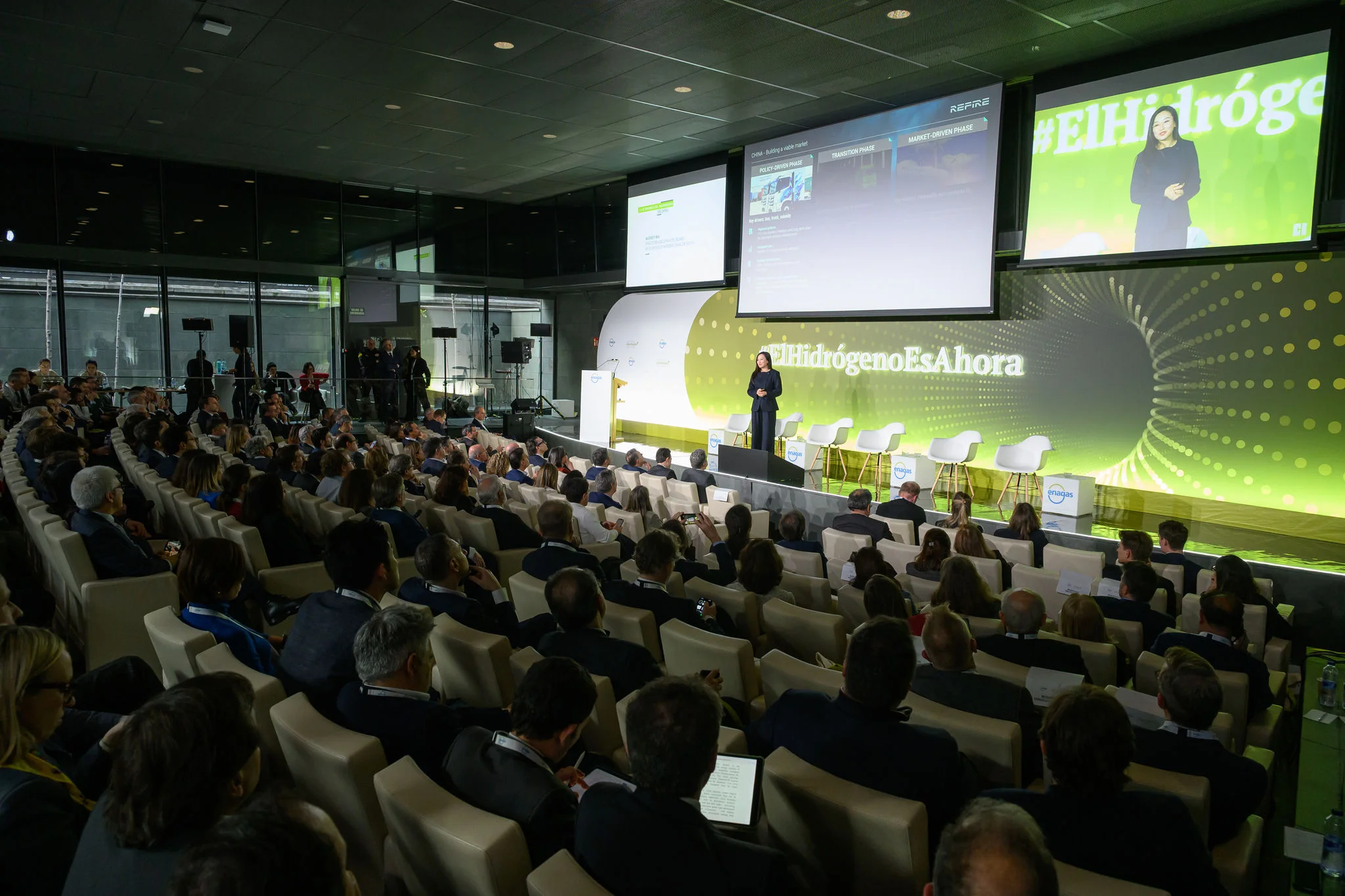
China accounts for over half of the green hydrogen production capacity currently operational around the world. Moreover, 94 of the 510 projects globally committed until 2030 (in other words, almost one in five) are located in China. These data, presented by Audrey Ma, Executive Director of the Board and VP of International Business at REFIRE during the 4th Hydrogen Day organised by Enagás, confirm that the deployment of hydrogen in the Asian country is real and that it will continue to increase in the coming years.
This leadership is complemented by the capacity of the final investment decision (FID) that it has achieved. Global financing for 35 GW of renewable hydrogen has been secured and China accounts for approximately 55% of this capacity, yet another indicator of the country’s commitment to undertaking large-scale projects.
One of the keys to China’s development of renewable hydrogen is a combination of factors, including the execution of the projects, the approval of policies to promote hydrogen and the development of the infrastructure and technology required to build a market capable of connecting supply and demand.
510 global hydrogen projects have been committed for 2030, with their associated investment totalling about 100 billion euros
China also stands at the forefront of technological deployment. It’s the country leading the global development of electrolysis, the technology that can divide water (H2O) into hydrogen and oxygen by using electricity from renewable sources, including solar and wind power. Its position can be put down to the incorporation of green hydrogen as a key vector into its five-year plans, articulating incentives, deployment goals and support for R&D (research and development).
“We’re shaping the market in a coordinated manner, ensuring a balance between supply and demand in each project that we implement”, explained Ma.
As a result, industry has responded with the development of greater capabilities throughout the value chain: mass manufacture of electrolysers, integration with large-scale renewable projects, the deployment of fuel cell vehicles and the consolidation of industrial demand in sectors such as refining, ammonia and steelmaking.
China is the world’s largest consumer of hydrogen, primarily for traditional industrial uses
There is also a structural factor that explains the speed of the deployment: domestic demand. The Global Hydrogen Review 2025 published by the International Energy Agency (IEA) indicates that China was the world’s largest hydrogen consumer, accounting for over a quarter of global consumption. The country’s energy security is being reinforced by gradually transforming this demand towards low-carbon hydrogen. Reducing its dependence on imported fossil fuels against a backdrop of geopolitical volatility is a strategic priority. In particular, with regard to renewable hydrogen, this allows the use of indigenous resources such as the wind and sun, especially in inland regions, to transport the energy to the major industrial hubs in the east.
According to Ma, around 80% of the hydrogen purchase contracts in China are concentrated in three major sectors: ammonia production, oil refineries and power generation. These are energy-intensive industries in which hydrogen plays a natural role.
Two projects illustrate this scale:
In addition, according to the Hydrogen Council, China accounts for 35% of the firm global agreements involving buyers (industry, energy companies, etc.) that have committed to purchasing renewable hydrogen in the future. The project portfolio anticipates 1.6 million tonnes of annual supply assigned to meeting the growing domestic demand, entirely through national production.
A viable market needs infrastructures. China has already put into operation two pipelines exclusively devoted to hydrogen transmission. The first, approximately 400 kilometres long, connects the region of Inner Mongolia (one of the country’s major renewable energy bases, with plentiful wind and solar resources) and Beijing, one of the main energy consumption and industrial hubs. This infrastructure can transmit the hydrogen produced using renewable energies from the interior to urban and industrial centres where the demand is higher.
The second pipeline, 160 kilometres long, has a similar logic, albeit on a regional scale. It connects a renewable energy production hub with nearby industrial areas, facilitating a continuous supply to end customers in sectors such as chemicals, refining and heavy transport. Although shorter in length, its significance is strategic, as it demonstrates a will to develop hydrogen-dedicated corridors alongside the conventional energy network.
The role of the operators of the energy infrastructures is key in this respect. This is because connecting multiple local production and consumption hubs through dedicated networks is vital to consolidate regional hydrogen markets.
In China, there are now about 39,000 registered and commercially deployed fuel cell buses and lorries
“Collectively, South Korea, Japan and China have deployed over 85% of global hydrogen mobility, with more than 90,000 units”, explained Ma. In China, there are now about 39,000 registered and commercially deployed fuel cell buses and lorries. There are also over 630 hydrogen refuelling stations. These figures are higher than in Japan, where there are 9,450 vehicles and 150 stations. South Korea has the most vehicles (43,500), but not the highest number of stations (234).
The evolution of hydrogen in China can be divided into three major phases: the first driven by policies, the second involving the transition to the market and the third geared towards demand.
In 2021, China launched an initiative involving five urban demonstration clusters with more than 40 participating cities. The programme came to an end in 2025 and further support policies are being discussed. The incentives include subsidies for purchases of vehicles and aids for investment and operating hydrogen refuelling stations, as well as refuelling subsidies.
This will result in the above-mentioned 39,000 fuel cell vehicles being cumulatively deployed, with over 630 refuelling stations built across the country.
Moreover, ten provinces and cities have implemented toll exemptions and reductions for hydrogen-powered heavy goods vehicles, thus significantly improving the total cost of ownership (TCO).
This phase gives rise to the concept of “sector coupling”: integration between energy production, industry, mobility and chemistry.
China has shown that the hydrogen economy is evolving from public policies towards the market, connecting renewable production, industrial demand and transport networks in a single scenario involving decarbonisation, efficiency and the energy transition.

